
Discover the Origins & History of Coffee—American’s Favorite Hot Drink
Coffee, the invigorating, aromatic drink enjoyed by millions of Americans every day, has a fascinating history that started centuries ago. Today, coffee has become an integral part of American culture—whether it’s your morning pick-me-up, an afternoon break, or a way to socialize with friends.
But how did coffee become such a staple in American life? How did it get to be that steaming cup of goodness many of us rely on every day?
To get the whole story, we have to travel back in time to its origins in the distant lands of Africa and then follow it through the Arabian Peninsula, Europe, and then to the New World.
Join us, won’t you?
The Mythical Origins of Coffee
According to legend, the discovery of coffee dates back to the 9th century in the Ethiopian highlands. The story goes that a goat herder named Kaldi noticed his goats acting unusually energetic after eating the red berries from a certain tree. Curious, Kaldi tried the berries himself and experienced a similar burst of energy. Word of this magical fruit reached a local monk, who made a drink from the berries and found that it helped him stay awake during long hours of prayer.
While this story is charming, it is likely more myth than fact. Nonetheless, Ethiopia is widely considered the birthplace of coffee. Coffee plants grow naturally in the region, and historical evidence suggests that people in Ethiopia were familiar with coffee for centuries before it became a global commodity. Local tribes may have consumed coffee in various ways, including grinding the beans and mixing them with animal fat to create a kind of energy-rich paste.
Coffee is Introduced to the Arab World
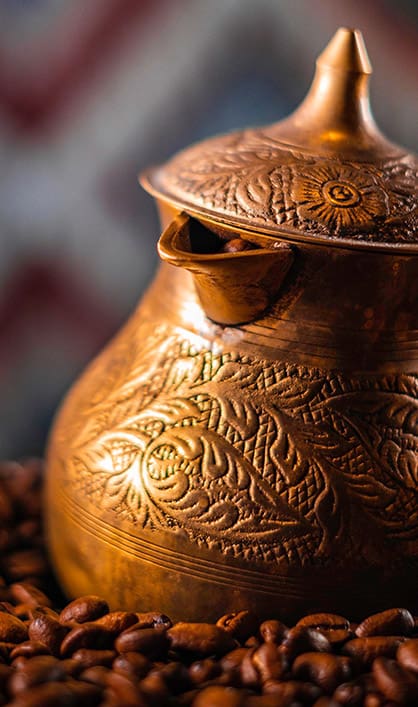
Coffee’s next major chapter began when it made its way across the Red Sea to the Arabian Peninsula. By the 15th century, coffee was being cultivated and traded on the peninsula, particularly in the Yemeni port of Mocha. It was here that the drink began to resemble what we recognize as modern-day coffee.
In Yemen, coffee was primarily consumed in Sufi monasteries, where it was used to help the Sufi mystics stay awake during their nightly religious rituals. The beverage quickly spread throughout the Muslim world, partly because it was seen as a good alternative to alcohol, which is forbidden in Islam. Coffeehouses, known as qahveh khaneh, sprang up in cities across the Middle East, becoming important social and intellectual hubs. These coffeehouses were not just places to enjoy a hot drink; they were venues for music, conversation, political debate, and even chess.
By the 16th century, coffee had reached Persia, Egypt, Turkey, and North Africa. In the Ottoman Empire, coffee became a central part of courtly life. The Ottoman sultans were enthusiastic coffee drinkers, and the beverage was served in elaborate ceremonies at the royal palace in Istanbul. The association of coffee with social interaction and intellectual discourse solidified its status as a drink of sophistication and culture.
Coffee Arrives in Europe
Coffee made its European debut in the early 17th century, brought by traders, pilgrims, and diplomats returning from the Middle East. Initially, it was met with suspicion and even hostility. Some Europeans referred to the drink as “the bitter invention of Satan.” In 1615, Venetian merchants began importing coffee into Europe. Its popularity grew steadily, particularly among the wealthier and more educated classes.
In 17th-century Europe, coffeehouses became vital social centers. The first coffeehouse in England opened in Oxford in 1650, and soon after, London saw its first coffeehouse in 1652. These establishments quickly became known as “penny universities” because, for the price of a penny, patrons could enjoy a cup of coffee while engaging in lively discussions about politics, science, philosophy, and art. Notably, many of the coffeehouses in London were frequented by the scientists and intellectuals who helped spark the Enlightenment.
By the 18th century, coffeehouses had spread across Europe, and coffee was an integral part of European society. Coffee even became a political symbol in places like France, where it was associated with revolutionary ideas.
Coffee and the New World
Coffee reached the Americas during the 17th century, brought by European colonizers. While tea initially dominated the American colonies, coffee began gaining ground, especially after the Boston Tea Party in 1773. The American colonists’ rebellion against British taxation on tea made coffee a patriotic alternative to tea, and drinking it became an act of resistance.
By the early 19th century, coffee had become a popular drink in the United States, and advances in transportation and technology further boosted its consumption. Steamships and railroads made it easier to import coffee beans, while innovations like the percolator, patented in 1889, made brewing coffee simpler and more efficient.
In the 20th century, coffee consumption skyrocketed in the United States, especially during and after World War II. American soldiers were supplied with instant coffee, which was lightweight, easy to prepare, and provided a quick energy boost. This led to a widespread post-war culture of coffee drinking. The advent of instant coffee also made it more accessible to the average American household.
Coffee in American Culture Today
Today, coffee is deeply ingrained in American culture. According to the National Coffee Association, more than 60% of Americans drink coffee daily. Whether it’s a quick cup from a fast-food drive-thru, a meticulously crafted pour-over from a local roastery, or a pumpkin spice latte from a chain café, coffee plays a role in the lives of millions.
Coffee has become more than just a drink; it symbolizes comfort, productivity, and social connection. For many, the day doesn’t truly begin until they’ve had their morning cup. Coffee fuels the workforce, accompanies conversations with friends, and provides moments of solace during a hectic day. Moreover, coffee’s global reach continues to expand, with new trends like cold brew, nitro coffee, and plant-based milks offering even more variety to an already diverse drink.
At East Indies Coffee & Tea, we’re working to bring you the coffees that you and your patrons want, as well as the services you need. From private labeling to fundraising—as well as custom blends, roasts, and packaging—we’ve got what you need to make the coffee experience in your corner of the world something special.


Join the Coffee Craze with Products from East Indies Coffee & Tea
From its ancient origins in Ethiopia to its current status as America’s favorite hot drink, our love for coffee has spread across continents, cultures, and centuries. What started as a mysterious, energizing berry has become a global phenomenon, deeply woven into the fabric of American life.
Whether enjoyed in the quiet of a morning ritual or as a shared experience in a bustling café, coffee has a unique ability to connect people, stimulate conversation, and awaken the senses. As it continues to evolve, one thing is certain: coffee is here to stay.
We invite you to browse our selection of coffees and become an East Indies reseller today!
Interested in buying tea? Have a look at our wide selection of teas and contact us with questions, comments, or for more information.